

A Market Feasibility Study is crucial to conduct when a company has a product idea that seems promising for development.
A company may have an interesting concept, market demand might look large, and revenue projections might show high growth potential. However, in practice, this concept must be tested because not all products or things to be developed have the potential to generate real demand when launched to the market.
This problem often occurs because companies focus too quickly on product development without first ensuring whether the market truly needs the solution offered. Even products with superior technology can fail if they lack a clear target consumer, realistic market size, or an appropriate marketing strategy.
Therefore, through a market feasibility study, companies can evaluate market opportunities, understand consumer behavior, and validate demand before allocating significant resources to new product development. Let’s understand more deeply what a market feasibility study is.
Why Does an Interesting Product Idea Not Necessarily Have Market Opportunity?
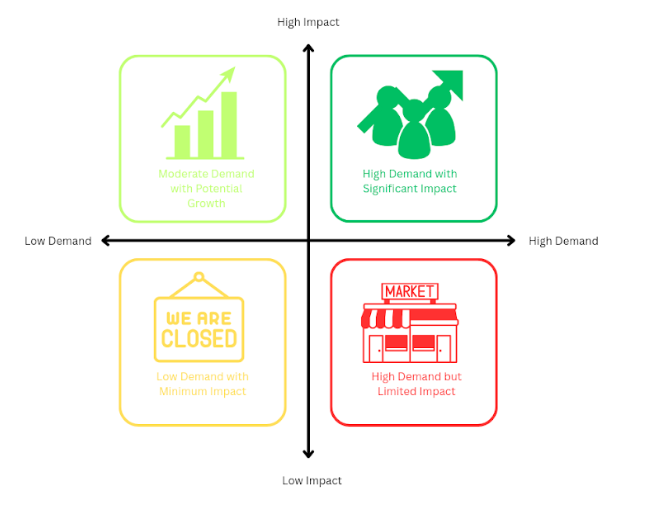
A company can create a product with various superior features, but if customers do not have a problem they want to solve or do not see enough value from the product, adoption rates will remain low.
This is why the demand validation process is an important part of business development. Before entering the production or expansion stage, companies need to ensure several fundamental questions:
Is there a real need in the market? Who are the primary customers most likely to buy? And how large is the potential market that the company can reach?
These questions form the basis for conducting a market feasibility study, and by understanding these factors early on, companies can reduce investment risks that do not yield results according to expectations.
Understanding Market Feasibility Study as the Foundation for Business Validation

Unlike just conducting a market survey, a market feasibility study has a broader scope of analysis. Companies do not just find out if consumers like a product, but also evaluate whether there is a sustainable business opportunity in the long term.
In the process, a market feasibility study usually covers several key aspects, ranging from analyzing customer characteristics, industry trends, and purchasing behavior to estimating market size. This information is then used to determine if an opportunity has a level of feasibility that aligns with the company’s strategic goals.
This approach is increasingly important when companies want to enter new markets, launch innovative products, or diversify their businesses. Without sufficient market understanding, investment decisions are often based only on optimistic assumptions that may not match actual conditions.
Therefore, a market feasibility study can be viewed as a business risk mitigation mechanism. Its goal is not to ensure that a product will definitely succeed, but to help companies understand the level of opportunity and risk before making decisions that have a major impact on organizational resources.
Discover More : Why Corporate Management Consulting Is Important in This Era of Complexity
Key Stages in a Market Feasibility Study

Conducting a market feasibility study is not just about finding out if consumers are interested in a product. This process requires a deeper analysis to understand whether the market opportunity is large enough, has real demand, and can be developed into a sustainable business.
Each company may have a different approach to conducting a market feasibility study. However, in general, there are several key stages that need to be followed so that the analysis results can provide a more accurate picture of a product’s potential.
1. Analysis of Consumer Needs and Market Behavior
The initial stage in a market feasibility study is understanding consumer needs and the problems that the developed product aims to solve. Many companies focus too much on explaining product features but pay less attention to the main reason why customers need that solution.
In fact, purchasing decisions are usually not just influenced by the existence of a product, but also by the level of urgency of the problem to be solved. Products that can answer important customer needs have a higher chance of adoption compared to products that only offer innovation without clear value.
In this stage, companies need to analyze several aspects such as customer characteristics, consumption patterns, factors influencing purchasing decisions, and market behavior changes. This data can be obtained through customer surveys, interviews, industry trend analysis, and evaluation of existing consumer behavior.
This approach helps companies avoid common mistakes in product development: creating a solution first and looking for a market afterward. Conversely, companies can build products based on a stronger understanding of real customer needs.
2. Validating Demand Before Investing More
After understanding market needs, the next stage is demand validation. This process aims to determine if there is real interest from customers in the product or service offered.
One of the biggest challenges in business development is distinguishing between consumer interest and actual purchasing decisions. Many customers might say that a product looks interesting, but they are not necessarily willing to spend money to use it.
Therefore, demand validation needs to be done using a more objective approach. Companies can test the market through a minimum viable product (MVP), pilot programs, customer interviews, or analysis of early adopter behavior.
The results of this process can provide a picture of market acceptance levels before companies spend more significant investments. If the market response is not as expected, companies still have the opportunity to make adjustments to the product or business strategy.
This approach also helps organizations reduce the risk of product-market mismatch, a condition where the developed product does not truly match the needs of the targeted customers.
3. Measuring Market Potential Through TAM SAM SOM Analysis
One of the important components in a market feasibility study is estimating market size. Companies need to understand how much opportunity is available before determining expansion strategies and resource allocation.
One method often used is TAM SAM SOM analysis. This framework helps companies view market potential gradually based on different scopes.
Total Addressable Market (TAM) describes the overall market potential if a product can reach all customers who have a need for the solution. This figure shows the largest opportunity size available in an industry.
However, companies cannot always reach the entire market. Therefore, the analysis continues through the Serviceable Available Market (SAM), which is the portion of the market that can realistically be served based on region, customer segment, or the company’s operational capabilities.
Then there is the Serviceable Obtainable Market (SOM), which is the portion of the market that the company can most realistically acquire in a certain period, considering competition, business capacity, and the marketing strategy owned.
Through this approach, companies can avoid overly optimistic projections. Many businesses fail not because the market opportunity does not exist, but because the market size estimate was made too large without considering the company’s actual ability to capture that opportunity.
4. Competitor Analysis and Product Positioning in the Market
Understanding market size alone is not enough to determine a product’s feasibility. Companies also need to know the competitive conditions they will face when entering the market.
Competitor analysis helps organizations understand who the key players in the industry are, what their strategies are, what advantages they possess, and what weaknesses might become opportunities for a new product.
In this stage, companies need to evaluate several aspects such as pricing strategy, product quality, customer experience, distribution, and competitor brand strength. This information can be used to determine a more accurate product position in the market.
New products do not always have to be the option with the lowest price or the most features. In many cases, success is actually determined by the company’s ability to find a different market positioning and provide value that is relevant to customers.
By understanding competitor positions early on, companies can build more realistic strategies and avoid entering the market without a clear advantage.
Common Mistakes Companies Make When Conducting Market Feasibility Studies

Although a market feasibility study plays an important role in business decision-making, many companies still perform this approach incorrectly.
The first mistake is relying too much on internal assumptions. Product development teams often have strong confidence in the solutions they create, but that confidence does not necessarily reflect true customer needs.
The next mistake is only looking at market size without considering the company’s ability to win the competition. A large market does not always mean an easy business opportunity, especially if the industry has strong competitors with established positions.
Additionally, companies often ignore changes in consumer behavior. Historical data is indeed important, but market conditions can change rapidly due to technological developments, economic changes, or shifts in customer preferences.
Therefore, a market feasibility study must be viewed as a dynamic analysis process. The research results are not just numbers to support investment decisions, but become the basis of strategy so that companies can adapt to ever-changing market conditions.
Discover More : How Companies Read Supply and Demand Before Making Major Decisions
Connecting Market Feasibility Study Results with Business Strategy

Thus, the results of a market feasibility study should not stop as an analysis document before product launch. The greatest value of this process lies in how companies use those findings to determine the direction of their business strategy.
Conversely, if obstacles are found such as insufficient demand, excessive competition levels, or an unsuitable business model, companies still have room to make adjustments before committing larger resources.
This approach also shows that a market feasibility study is not intended to seek justification that a business idea will definitely succeed. Its main function is to help management understand market conditions more objectively so that decisions made have a more measurable level of risk.
Closing
Developing a new product always carries a level of uncertainty. No matter how strong the ideas a company has, success still depends on how the market responds to the solution.
Therefore, a market feasibility study is an important step to ensure that business decisions are not only based on internal optimism but are also supported by a structured market analysis.
Arghajata Consulting helps companies conduct comprehensive business opportunity analysis through market feasibility studies, market research, business model validation, competitor analysis, and preparation of data-based expansion strategies. With a structured approach, we help organizations make more accurate business decisions and build sustainable growth.