
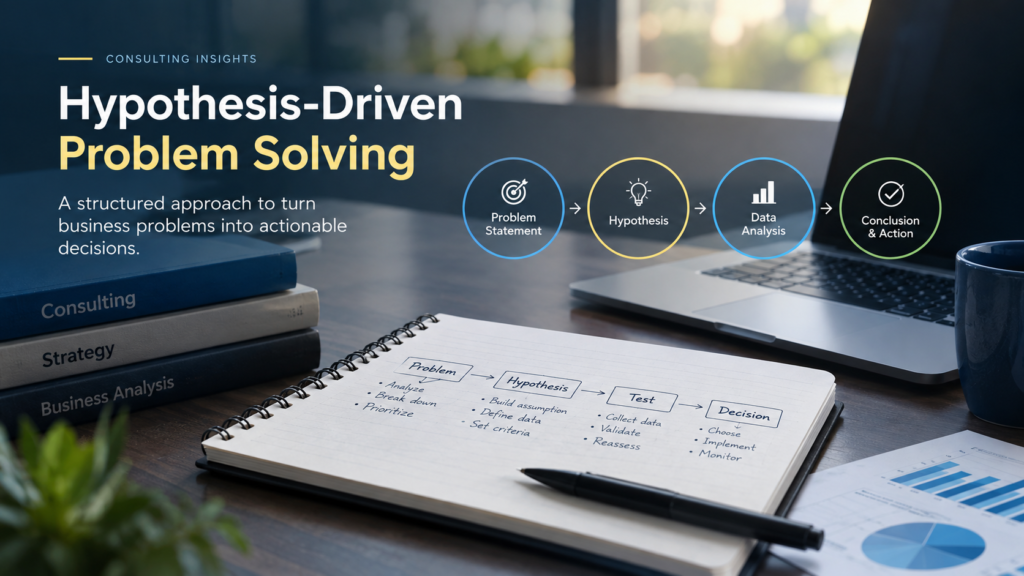
Hypothesis-driven problem solving is relevant because this approach begins by developing an initial assumption about the most likely cause of a problem and then testing it using relevant data.
If the evidence does not support the initial hypothesis, the team can adjust the direction of the analysis based on its findings. This approach is commonly used in strategy consulting to make the analysis process more focused and direct it toward issues with the greatest impact.
For companies, however, the benefit is not simply about solving problems faster. More importantly, it ensures that analytical resources focus on understanding the right problem.
Through structured problem solving, companies can make the business problem-solving process more systematic. Meanwhile, strategic data analysis can help teams test decisions rather than simply produce more reports. To learn more about how to solve problems through hypotheses, the following discussion provides an overview.
Why Can’t Complex Business Problems Be Solved with More Data Alone?

Before understanding what Hypothesis-driven problem solving is, it is important to first understand why complex business problems cannot be solved with data alone and why they also require hypotheses.
There is an assumption that the more data a company collects, the more accurate its decisions will be. Data is indeed necessary to understand business conditions. However, collecting data without a clear analytical direction can make the decision-making process more complicated. Teams may spend time comparing various indicators without knowing which information is actually needed to explain the problem.
All of this information may be relevant. However, the level of relevance varies. A decline in margin may result from an increase in raw material costs, but it may also come from changes in the product mix, excessive discounts, declining productivity, or the loss of customers with high margin contributions.
Without a clear analytical structure, all of these possibilities may appear equally important. Teams can end up spending time examining various factors at the same time, even though only a small number of them actually have a significant impact on the problem.
This condition often causes the analysis process to experience analysis paralysis. Information continues to increase, but the team does not make a decision because it still feels that it needs additional data before determining the appropriate course of action.
Hypothesis-driven problem solving addresses this issue by providing direction from the beginning. Teams can develop assumptions about the causes of a problem, identify the evidence needed to test them, and focus the analysis on the most relevant information. With this approach, the analysis process does not begin with as much data as possible. Instead, it starts with the problem that needs to be explained and the most viable hypothesis to test.
Discover More: Sustainability: Pengertian, Contoh, dan Prinsip Dalam Bisnis
Starting with a Problem Statement, Not Jumping Directly to a Solution

Hypothesis-driven problem solving is an approach that begins with a clearly defined problem statement. The hypothesis then serves as an initial assumption that can be tested against factual evidence. By focusing the analysis on the most relevant potential root cause, companies can reduce the risk of adopting a solution before fully understanding the problem.
For example, the statement “the company’s sales are declining” is still too broad to serve as a basis for analysis. The team can narrow it down to “the decline in sales is primarily caused by a decrease in the purchasing frequency of key customers over the past six months.” This statement can then be translated into a hypothesis and tested using transaction data, customer behavior, and changes in market conditions.
This approach makes the analysis more focused because teams do not need to collect all available data. Instead, they can prioritize data based on its ability to test the hypothesis. If the evidence does not support the initial assumption, the hypothesis can be rejected and the analysis redirected toward other possible causes.
It also helps prevent solution bias, which refers to the tendency to determine a solution too quickly before understanding the root cause. In the context of consulting, the ability to formulate problems and develop testable hypotheses is an important part of structured problem solving. A well-defined problem statement helps teams identify relevant analyses, prioritize data, and avoid spending time on factors that have little connection to the business problem.
Using the MECE Framework to Break Down Problems

After formulating the problem statement, the next step is to break the problem down into smaller parts so that the team can analyze it systematically. One framework that can be used is MECE, which stands for Mutually Exclusive, Collectively Exhaustive.
In the application of hypothesis-driven problem solving, teams can use the MECE framework to determine which areas need to be tested first. Each part of the problem can then serve as a basis for developing a more specific hypothesis and testing it with relevant data.
For example, a company wants to understand the causes of declining revenue. The team can break revenue down into several components, such as the number of customers, transaction frequency, and transaction value. These three components provide an initial structure for identifying where the decline in revenue may come from.
Based on this structure, the team can develop several hypotheses. For example, the decline in revenue may result from a decrease in the number of customers, lower purchasing frequency among existing customers, or a decline in average transaction value. The team can then test each hypothesis using sales and customer behavior data.
In this way, MECE is not only used to make a problem appear more organized. The framework helps transform a broad problem into a series of analytical questions that the team can test one by one.
This approach also helps avoid two issues that commonly arise in business analysis. The first is overlap, which occurs when several analyses examine the same factor. The second is blind spots, which occur when an important factor does not fall within the scope of the analysis.
Discover More : Eliminating Silo Mentality: How to Use the RACI Matrix for Team Accountability
From Problem Structure to Testable Hypotheses

After breaking the problem down into several parts, the next step is to determine the hypotheses that are most worth testing.
A hypothesis in this context is not simply a guess. It is an initial assumption based on available information, experience, historical patterns, and an understanding of the company’s conditions. The team then needs to test the hypothesis using relevant evidence and update it when the findings point in a different direction.
For example, a company experiences a decline in margin even though its sales volume continues to grow. One possible hypothesis is that the decline in margin mainly results from a shift in the sales mix toward products with lower margins.
Based on this hypothesis, the team can conduct more specific analyses. It can compare the contribution of each product category, examine changes in the sales mix, and measure their impact on gross margin.
If the data shows that sales of low-margin products have increased significantly, the initial hypothesis receives support. However, if the change in sales mix is not large enough to explain the decline in margin, the team needs to investigate other possible causes.
This is where a hypothesis differs from a conclusion. A hypothesis serves as a starting point for directing the analysis. The team should not maintain it simply because it was the first assumption made by management or the consultant. If the data shows that the initial hypothesis is incorrect, the team should revise or abandon it. The ultimate goal is not to prove that the first assumption is correct, but to find the strongest explanation based on the available evidence.
Avoiding Confirmation Bias in Decision-Making

A hypothesis-based approach also carries one risk that teams need to consider. When someone already has an assumption about the cause of a problem, they may only look for data that supports their belief and ignore information that contradicts it.
This phenomenon is known as confirmation bias. In a business context, this bias can make the analytical process appear objective because it uses data. However, the team may have already directed the analysis toward proving a particular assumption.
For this reason, a good hypothesis should identify not only the data that can support it, but also the evidence that could disprove it.
For example, a team suspects that declining sales result from product prices that are too high. The analysis should not only look for evidence that customers are sensitive to price. The team should also examine whether competitors with higher prices experienced a similar decline.
The team should also assess whether customer volume changed after the price increase and whether other factors could explain the change.
This approach makes the analytical process more objective. The team treats the hypothesis as a tool for directing the investigation, rather than as a conclusion that it must defend.
In consulting practice, the ability to challenge one’s own assumptions can be just as important as the ability to find supporting evidence. Good decisions do not come from hypotheses that are always proven correct. They come from a process that allows teams to correct their hypotheses when the evidence points in a different direction.
Turning Analysis Results into Business Decisions

The final stage of hypothesis-driven problem solving is not simply producing an analytical report. The real value emerges when the findings can help management determine clear actions.
After testing the hypothesis and identifying the key factors, management needs to translate those findings into decisions. If the main problem comes from the cost structure, for example, the company may renegotiate supplier terms, change operational processes, or adjust its product portfolio.
Conversely, if the root cause comes from declining demand, the company may need a different approach. It may need to reassess its pricing strategy, customer segmentation, value proposition, or distribution channel effectiveness.
The relationship between analysis and decision-making should remain explicit. Each recommendation should connect to the findings that support it. This allows management to understand why the company selected one action over other alternatives.
This also helps companies avoid solutions that only address symptoms. When the team understands the root cause through a structured analytical process, the actions it takes have a greater chance of producing sustainable change.
Why Is This Approach Widely Used in Consulting?
In the consulting world, the time available to understand a client’s problem is often limited. Consultants also do not always have access to all the information held by the company from the beginning.
For this reason, consultants need to build a problem structure, determine hypotheses, and identify the most relevant data as efficiently as possible.
The hypothesis-driven approach helps narrow the search without eliminating the possibility of changing direction when new evidence emerges. The process becomes more iterative: the team formulates the problem, develops hypotheses, analyzes data, evaluates the findings, and refines the hypotheses when necessary.
This framework also makes communication with management simpler. Instead of presenting dozens of findings without clear priorities, the team can explain the key factors that have the greatest influence on the problem along with the evidence that supports them.
Ultimately, speed in problem solving does not mean making decisions hastily. It means focusing attention on what matters most without spending resources on analysis that does not provide additional value.
Conclusion
Hypothesis-driven problem solving does not mean ignoring data or making decisions based on assumptions. Instead, this approach makes the use of data more focused because every analysis has a clear purpose.
By starting with a problem statement, breaking down the problem using the MECE framework, developing hypotheses, and testing them with relevant data, companies can address complex problems through a more systematic thinking process.
It is important to remember that a hypothesis is not the final answer. It is only the starting point for finding the strongest explanation based on evidence. When the data shows that the initial assumption is incorrect, organizations must be prepared to change the direction of the analysis.
This capability becomes increasingly important when companies face decisions with significant consequences. In such situations, the quality of decisions depends not only on how much data management has, but also on its ability to turn that data into relevant insights and appropriate actions.
Arghajata Consulting helps companies address various business challenges through structured, data-driven analytical approaches aligned with strategic objectives. From business problem assessment and strategic analysis to the development of recommendations and implementation, we help management gain a clearer perspective before making important decisions.