
The unemployment rate is one of the key indicators used to understand labor market conditions and a country’s economic development. When the number of job seekers exceeds the availability of employment opportunities, unemployment can increase and potentially reduce consumer purchasing power, business activity, and economic growth.
However, unemployment is not solely related to limited job opportunities. Changes in industry requirements, mismatches between workforce skills and employer needs, and technological developments can also affect employment conditions. Therefore, understanding unemployment rates requires consideration of various factors influencing the labor market.
So, how is the unemployment rate measured, and what factors contribute to unemployment? Explore the following discussion on its definition, causes, economic impacts, and measures to address unemployment.
What Is the Unemployment Rate and the Open Unemployment Rate (TPT)?

Unemployment refers to a condition in which an individual who is part of the labor force does not have a job. In Indonesia’s labor statistics, unemployment includes individuals who are actively seeking employment, preparing to start a business, not looking for work because they believe they are unlikely to find a job, or have secured employment but have not yet started working.
In Indonesia, this condition is measured using the Open Unemployment Rate (TPT). TPT represents the percentage of unemployed individuals relative to the total labor force. This figure indicates the proportion of the labor force that has not been absorbed into employment.
To understand unemployment rates, it is important to distinguish between the working-age population and the labor force. According to the definition used by Statistics Indonesia (BPS), the working-age population consists of individuals aged 15 years and above, while the labor force includes working-age individuals who are either employed or unemployed.
Therefore, not everyone in the working-age population is part of the labor force. For example, individuals who are still attending school or managing household responsibilities and are not seeking employment are not included in the labor force.
TPT is an important indicator because it provides an overview of the economy’s ability to generate employment opportunities. However, this figure does not fully reflect the quality of employment. Conditions such as employees working fewer than normal working hours or holding jobs that do not match their skills also need to be considered to gain a more comprehensive understanding of the labor market.
What Are the Conditions and Challenges of the Open Unemployment Rate in Indonesia in 2026?
Indonesia’s Open Unemployment Rate (TPT) has shown improvement, although several employment challenges still require attention. According to data from Statistics Indonesia (BPS), the national TPT in August 2026 declined compared to the same period in the previous year. However, this improvement does not fully reflect employment conditions across all population groups.
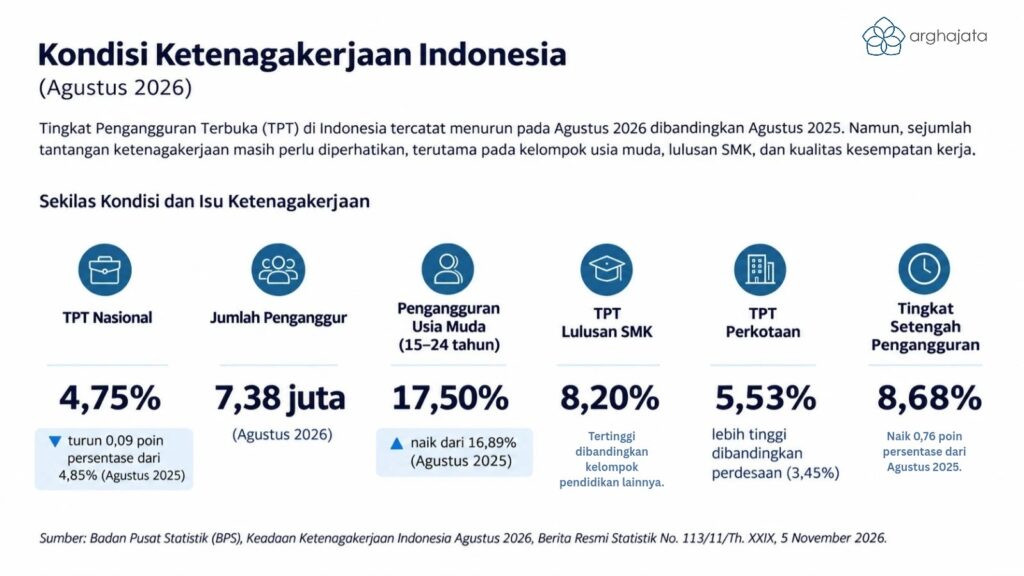
As illustrated in the infographic, employment challenges remain evident in the high unemployment rates among young people and vocational high school (SMK) graduates, as well as differences in unemployment rates between urban and rural areas. In addition, the underemployment rate indicates that some employed individuals still face limitations in their working hours.
These conditions demonstrate that a declining TPT needs to be accompanied by improvements in job quality and more equitable access to employment opportunities. Efforts to increase workforce absorption should also consider the alignment between workforce skills and industry requirements to ensure sustainable improvements in employment conditions.
Factors Contributing to Unemployment

Unemployment can occur due to various factors arising from both economic conditions and the characteristics of the workforce itself.
The availability of employment opportunities, industry requirements, and technological developments can influence an individual’s chances of finding employment. Several factors that may contribute to unemployment include:
Imbalance Between Labor Supply and Job Availability
One of the causes of unemployment is an imbalance between the number of job seekers and available employment opportunities.
When the labor force grows faster than the creation of new jobs, not all job seekers can be absorbed by companies or business sectors.
This situation can become more pronounced when investment growth and business activities are unable to generate sufficient employment opportunities.
As a result, competition for jobs becomes more intense, particularly in regions with a high number of job seekers.
Skills Mismatch with Industry Requirements
Unemployment can also occur when job seekers’ skills and qualifications do not align with company requirements. Industrial developments have increased the demand for specific competencies, including technical, digital, and other professional skills.
However, not all job seekers possess the experience or skills required for available positions. This mismatch can make vacancies difficult to fill while some workers continue to struggle to secure employment.
Slowing Economic Growth
Economic conditions also influence companies’ ability to recruit workers. When economic growth slows, demand for goods and services may decline, placing pressure on company revenues.
Under these circumstances, companies may reduce recruitment, postpone expansion plans, or implement operational efficiency measures. If these conditions persist, labor demand may decrease, increasing the risk of unemployment.
Technological Developments and Automation
Technological advancements and automation can change workforce requirements across various industries.
Certain jobs previously performed manually are increasingly being replaced by machines, software, or automated systems to improve operational efficiency.
These changes may reduce labor demand for certain types of jobs, particularly those involving routine and repetitive tasks. On the other hand, technological developments also create new types of employment that require different skills.
Workers who are unable to adapt to these changes may face difficulties in obtaining or maintaining employment.
Discover More : Why Is a Customer-Based Business a Strategic Asset That Determines Business Value?
What Are the Impacts of Unemployment on the Economy?

Unemployment can have widespread consequences because it is directly linked to household economic activities and business operations.
When more workers remain unemployed, household income decreases, purchasing power weakens, and economic productivity may decline. These impacts can be observed in several areas.
Impact on Household Income and Purchasing Power
Job loss can reduce individual and household income, potentially affecting their ability to meet daily needs.
This condition also requires households to adjust their spending, from reducing consumption to postponing certain purchases. If unemployment persists, it can also increase the risk of difficulties in meeting basic needs.
Declining income can also affect consumer purchasing power on a broader scale. When many households reduce their spending, demand for goods and services weakens.
As a result, businesses may experience declining sales and need to adjust their operations.
Impact on Productivity and Economic Growth
Unemployment results in a portion of the workforce with productive capabilities and potential remaining underutilized in economic activities. Labor is one of the key factors of production that contributes to the creation of goods and services.
When the number of unemployed workers increases, an economy’s production capacity may remain below its potential. In the long term, prolonged unemployment can also lead to a deterioration of workforce skills due to limited opportunities to apply or develop them. These conditions can hinder productivity and economic growth.
Impact on Social Conditions
Prolonged unemployment can create social and psychological pressures on individuals and their families.
Income uncertainty, difficulties in meeting basic needs, and limited employment opportunities can increase stress and reduce household well-being.
At the societal level, high unemployment rates may also widen economic inequality. Groups that struggle to find employment may face increasingly limited access to income and opportunities to improve their standard of living.
Nevertheless, these social impacts do not always occur to the same extent, as they are influenced by family circumstances, social protection systems, and living environments.
Impact on Businesses
High unemployment rates can affect business performance through declining market demand and changes in labor market conditions. Weaker consumer spending may put pressure on sales, requiring companies to adjust production capacity, operating expenses, and business development plans.
From an employment perspective, an increasing number of job seekers can expand the pool of candidates available to companies. However, greater labor availability does not always translate into a better match between workforce competencies and industry requirements. Consequently, companies may continue to face challenges in recruitment and in securing workers with the appropriate skills.
How to Measure the Unemployment Rate in Indonesia

In Indonesia, unemployment is measured using the Open Unemployment Rate (TPT) indicator published by Statistics Indonesia (BPS). This indicator represents the percentage of unemployed individuals relative to the total labor force during a specific period.
Before calculating TPT, it is important to understand that the labor force includes working-age individuals who are either employed or unemployed. Meanwhile, working-age individuals who are not employed and do not meet the criteria for unemployment, such as those attending school or managing household responsibilities, are classified as being outside the labor force.
Mathematically, the TPT formula is:
TPT = (Number of Unemployed Individuals ÷ Total Labor Force) × 100%
For example, if a region has a labor force of 1,000,000 people, of whom 50,000 are unemployed, the calculation would be:
TPT = (50,000 ÷ 1,000,000) × 100% = 5%
This means that approximately five out of every 100 people in the labor force are unemployed.
BPS collects employment data through the National Labor Force Survey (Sakernas). This survey serves as one of the main sources for assessing employment conditions in Indonesia, including the number of employed individuals, unemployed individuals, and the labor force participation rate.
Nevertheless, TPT cannot be used as the sole measure of labor market quality.
This figure does not fully capture workers who work fewer hours than they would prefer, mismatches between job requirements and workers’ skills, or the adequacy of wages.
Therefore, TPT needs to be analyzed alongside other labor market indicators to obtain a more comprehensive understanding of employment conditions.
Discover More : AI Adoption Strategy for Companies: Steps to Build a Structured Digital Transformation
How Can Unemployment Be Reduced?

Addressing unemployment requires efforts involving various stakeholders. The government plays a role in establishing policies that support job creation, while businesses contribute by generating employment opportunities and developing workforce competencies.
Meanwhile, individuals also need to improve their skills to adapt to changing labor market requirements. The following measures can help reduce unemployment rates while improving workforce quality.
Improving Education Quality and Workforce Skills
Education and training are important factors in preparing the workforce to meet industry requirements. Educational curricula need to align with developments in the labor market to ensure graduates possess relevant knowledge and skills.
In addition to formal education, vocational training, competency certification, and upskilling programs can help job seekers improve their competitiveness. With skills that meet company requirements, workers can increase their chances of securing employment.
Expanding Employment Opportunities
The government can encourage job creation through infrastructure development, increased investment, and policies that support business activities.
Investment across various sectors can potentially increase labor demand, both for operational positions and roles requiring specialized expertise.
However, expanding employment opportunities also requires attention to their geographic distribution. If most jobs are concentrated in certain regions, people in other areas may continue to face limited access to employment.
Therefore, regional economic development and a more equitable distribution of investment are important components of reducing unemployment.
Supporting MSMEs and Entrepreneurship
Micro, Small, and Medium Enterprises (MSMEs) play a role in creating employment opportunities because their business activities are spread across various sectors and regions. Support for MSMEs can be provided through access to financing, business assistance, management training, and expanded market access.
In addition to encouraging the growth of existing businesses, entrepreneurship development can provide individuals with alternative opportunities to create their own employment.
Nevertheless, these efforts need to be supported by access to capital, business management capabilities, and an understanding of market needs to ensure long-term business sustainability.
Improving Access to Job Information and Employment Placement
Information gaps can make it difficult for job seekers to identify positions that match their capabilities. On the other hand, companies may also encounter challenges in reaching candidates who meet their qualifications.
Providing accessible job vacancy information, employment services, and job placement systems can help connect job seekers with companies.
Internship programs and collaboration between educational institutions and businesses can also serve as a bridge for recent graduates to gain experience before entering the labor market.
Conclusion
The unemployment rate is one of the indicators used to assess labor market conditions and a country’s economy. Through the Open Unemployment Rate (TPT), the government can measure the proportion of unemployed individuals relative to the total labor force.
However, this figure needs to be considered alongside other employment indicators to ensure that labor market assessments are not limited to the number of people without jobs.
Unemployment can result from various factors, including limited job opportunities, skills mismatches, economic slowdowns, and technological developments. Its impacts can be reflected in declining purchasing power, productivity, economic growth, and social well-being.
Therefore, addressing unemployment requires a comprehensive approach. Improving workforce quality, expanding employment opportunities, supporting MSMEs, and improving access to job information need to be implemented in parallel.
Through these efforts, the labor market is expected to become more productive and capable of providing broader employment opportunities for the population.
In response to changing labor market dynamics, companies need human resource management strategies that can address evolving industry requirements. Workforce planning, competency development, and organizational effectiveness are important elements in building sustainable business competitiveness.
Arghajata Consulting helps companies formulate human resource management and organizational development strategies through a structured and analytical consulting approach.