Indonesian aquaculture has significant global market opportunities for Golden Pomfret, Cantang Grouper, and Barramundi. With its extensive marine resources, diverse aquaculture commodities, and established seafood trade networks, the country has a strong foundation to expand its presence in international markets.
However, strong production potential does not automatically translate into export competitiveness. To succeed globally, Indonesian aquaculture producers must go beyond increasing output and consistently meet buyer expectations for price, quality, product specifications, and supply reliability.
To better understand these opportunities and challenges, the Feasibility and Market Assessment, supported by COAST Facility Indonesia and Indonesia’s Ministry of Marine Affairs and Fisheries (KKP), evaluated those three aquaculture commodities.
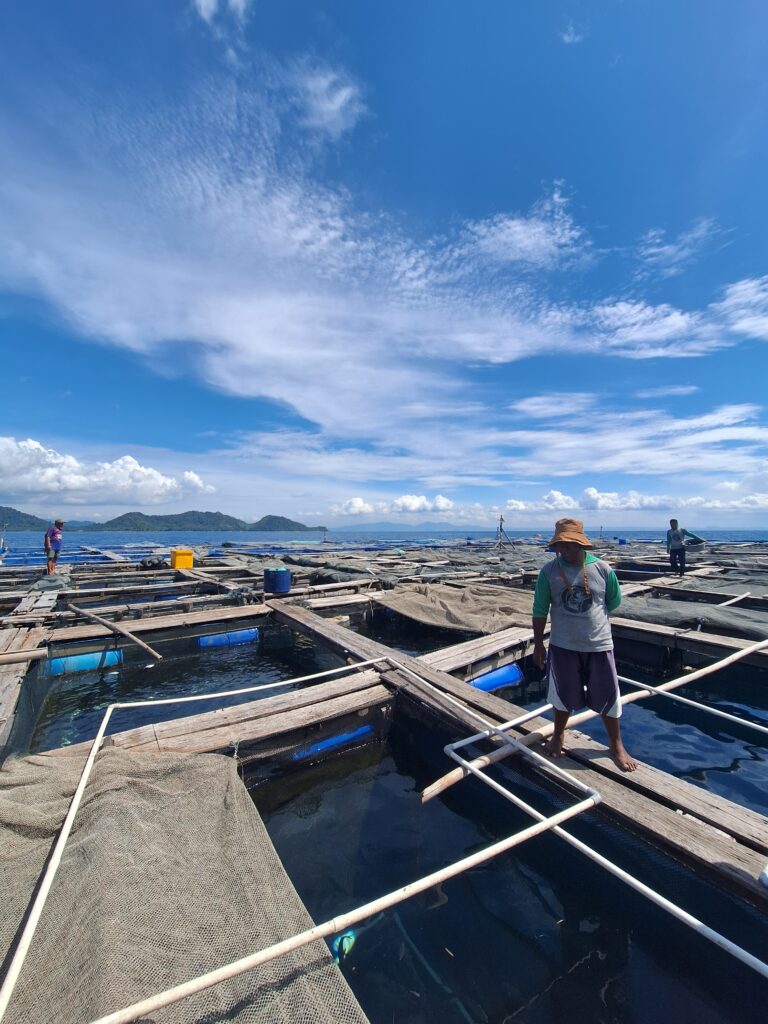
Through domestic and international market analysis, aquaculture feasibility assessments, consultations with exporters and industry stakeholders, and field observations in Lampung, Situbondo, Gili Ketapang – Probolinggo, and the Meranti Islands, the study examined each commodity’s market position and production readiness.
More importantly, the assessment goes beyond identifying potential export destinations. It explores what each commodity needs to strengthen its competitiveness, from meeting market requirements and addressing production constraints to building more reliable supply chains and commercial partnerships.
The findings highlight one key insight, it is that all three commodities offer export growth opportunities, but each requires a distinct development strategy. For Golden Pomfret, the priority is to build market recognition, validate buyer demand, and improve price competitiveness.
Meanwhile, Cantang Grouper can leverage existing trade channels by strengthening supply-chain coordination and aligning products with buyer requirements. In contrast, Barramundi must focus on improving production reliability and processing capabilities to capture opportunities in established markets.
Together, these findings demonstrate that unlocking Indonesia’s aquaculture export potential requires tailored strategies that connect market demand with competitive production and reliable supply.
Building on these insights, the following sections examine each commodity’s market opportunities, key challenges, and strategic priorities for sustainable export growth.
Golden Pomfret: Building Market Acceptance Before Scaling Production
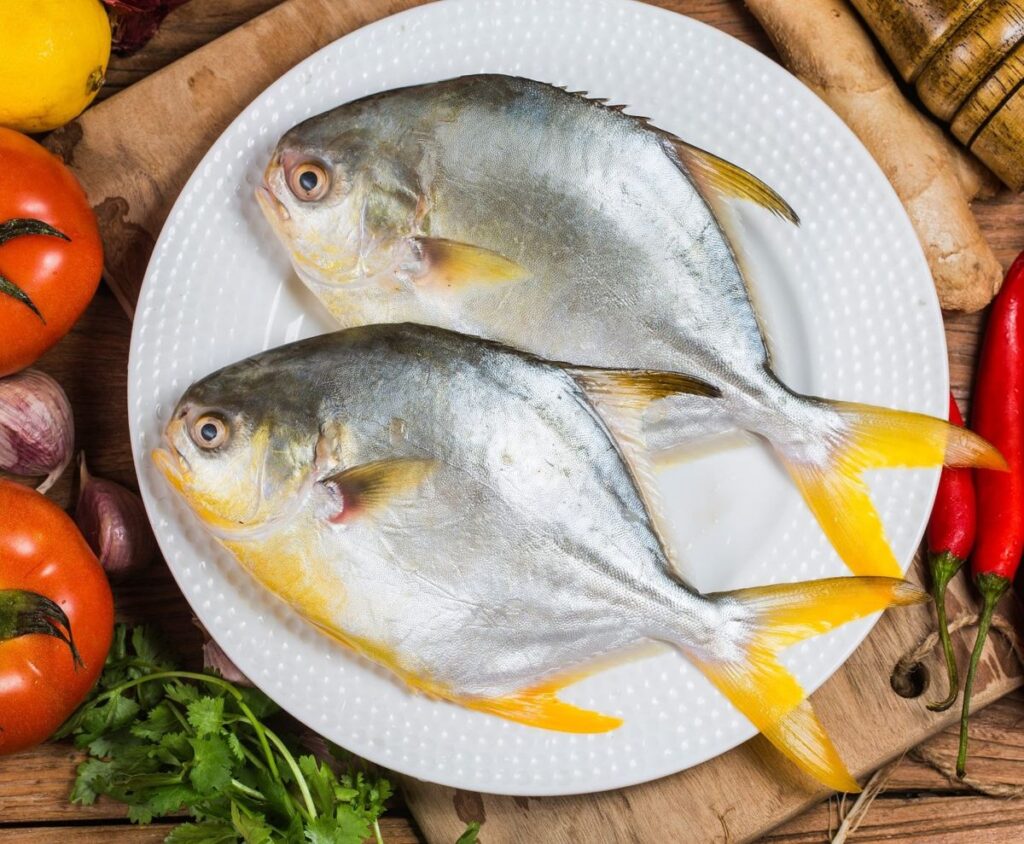
Global markets have long traded various pomfret species, particularly across China, Hong Kong, Vietnam, and the Middle East. However, demand remains concentrated on black and silver pomfret, which have established market positions and strong buyer familiarity.
Against this backdrop, Indonesia’s farmed Golden Pomfret has an opportunity to enter existing pomfret markets, but its acceptance among international buyers remains largely unvalidated. While the broader product category benefits from established demand, Golden Pomfret must still demonstrate its value to buyers who are accustomed to other species.
Therefore, the primary challenge is not simply identifying markets that consume pomfret, but establishing a compelling reason for buyers to choose Golden Pomfret. This requires clear product positioning, competitive pricing, and consistent quality and supply.
Market Opportunities Exist, but Price Competitiveness Remains a Key Barrier
Beyond market recognition, price competitiveness presents another critical challenge. Golden Pomfret currently commands a farm-gate price of approximately IDR 80,000–95,000/kg, limiting its ability to compete in international markets once processing, logistics, and export costs are considered.
For comparison, indicative international trade benchmarks for pomfret stand at approximately USD 5.4/kg in Italy, USD 5.0/kg in Hong Kong, and USD 4.6/kg in the United States.
While these benchmarks highlight potential market opportunities, they reflect broader pomfret trade rather than confirmed buyer prices for Indonesian Golden Pomfret. Consequently, exporters must validate actual buyer willingness to pay while improving production cost efficiency to establish a commercially viable export proposition.
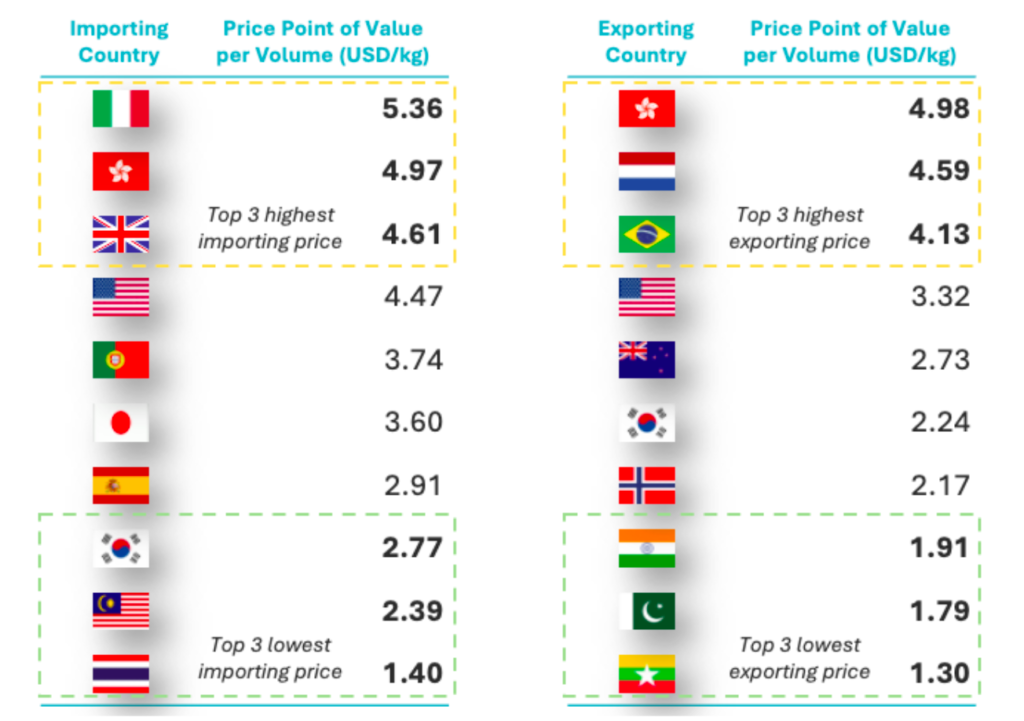
With current farm-gate prices approaching indicative international trade benchmarks, Golden Pomfret faces limited pricing headroom to absorb processing, packaging, logistics, and export costs. To address this gap, the assessment identifies a target farm-gate price of IDR 60,000–64,000/kg to strengthen export competitiveness.
However, cost reductions alone will not secure market acceptance. Indonesia must also position Golden Pomfret as a mid-to-premium farmed seafood product, differentiating it through consistent quality, reliable year-round supply, and product specifications aligned with buyer preferences.
Prioritizing Export Markets Before Scaling Production
| Global Market Preferences | |||||
| Area | Country | Market Preferences | Product Form | Main Attributes | Relevance for Indonesian Golden Pomfret |
| East Asia | China, Hong Kong | Preference for premium species such as silver pomfret; demand driven by consumer culture | Whole live and fresh fish | Freshness, appearance, texture, premium feel | Medium— Potential for whole fish, but demand validation is still needed as the market tends to prefer premium species |
| Japan | Preference for high-quality, standardized products, especially for specific cultural moments | Live fish, fresh whole, fillets and pieces | Consistent quality, soft texture, sweet taste, high food safety standards | Medium— Potential for whole fish, but still requires demand validation in the premium market | |
| Southeast Asia | Vietnam | Demand from traditional and modern retailers; preference for uniform sizes, generally under 1 kg | Fresh whole fish and frozen products | Freshness, consistent quality, clean white flesh, sweet taste | Medium— Relevant for fresh and frozen products if prices are competitive and supply is consistent |
| Malaysia | Well known in local consumption, but the market is price sensitive; the premium segment still tends to prefer silver pomfret. | Fresh whole fish and frozen products | Dense meat texture, sweet taste | Medium— Market familiarity, but price competitiveness remains a key factor | |
| Thailand | Preference for wild-caught black pomfret, especially from eastern Indonesia | Frozen whole fish and gutted fish | Dense texture, savory taste, larger fish size | Medium— Potential for frozen products, but Bawal Bintang requires market identification and buyer validation | |
| Middle East | Arab Saudi Arabia, UAE, Yemen, Oman, Qatar, Kuwait | End markets tend to absorb fillets and convenience products; there is a strong preference for white-fish species. | Frozen whole fish, gutted fish, and portions/fillets | White meat color, dense texture, food safety guarantee | Medium— Relevant for frozen whole or gutted fish products as the market has already shown demand for white-fish species. |
| North America | United States of America | Widely used in foodservice; preference is given to whole/gutted fish in BBQ dining and fillets/portions in HORECA | Frozen whole fish, gutted fish, portions/fillets | Consistent and dense texture, thick meat, clean taste, attractive appearance | Low–Medium— Potential exists, but market access is more limited due to buyer familiarity, species positioning, and food compliance. |
| Europe | English, Spanish, Portuguese, Italian | Preference for premium species such as silver pomfret | Live and fresh fish | Freshness, appearance, texture, premium quality, firm flesh, sweet taste | Low–Medium— Potential for whole fish, but still requires demand validation as the market tends to favor premium species |
The assessment highlights the need for a phased market-entry strategy, prioritizing markets with existing demand while validating buyer acceptance of Indonesian Golden Pomfret.
China emerges as an initial priority, supported by established demand for Indonesian pomfret. However, this demand largely reflects other pomfret species, making buyer validation essential before commercial expansion.
Building on this opportunity, Vietnam and the Middle East represent potential growth markets, although entry will depend on aligning product characteristics with local preferences. Meanwhile, Hong Kong and Italy offer relatively attractive indicative import prices, but require further validation of Golden Pomfret’s market acceptance and commercial viability.
Looking further ahead, the United States presents a longer-term opportunity for whole fish and processed products, subject to buyer acceptance, competitive pricing, and market requirements.
To translate these opportunities into commercial growth, Indonesia should validate demand before committing to large-scale production. This process should combine targeted buyer outreach, product sampling, quality testing, and pilot shipments to assess product-market fit and identify viable export channels.
The resulting market feedback will guide investment and expansion decisions. If export demand remains insufficient, strengthening domestic distribution through hotels, restaurants, catering, modern retail, and premium seafood channels can provide an alternative growth pathway.
Discover More: Food Security
Improving Production Cost Competitiveness
Alongside market development, improving production efficiency is essential to achieving export-competitive pricing. The assessment identifies opportunities to reduce unit production costs through coordinated improvements in feed costs, seed costs, and survival rates, while maintaining commercial viability for farmers.
| Golden Pomfret Production Cost Optimization Model | |||
| Component | Present condition | Moderate Scenario | Best Case Scenario |
| 1. Input and Scale of Production | |||
| Production cycle length (months/cycles) | 8 | 8 | 8 |
| Feed volume (tons/cycle) | 22,95 | 24,30 | 24,30 |
| Feed conversion ratio (FCR) | 2,50 | 2,50 | 2,50 |
| Number of cage plots | 60 | 60 | 60 |
| Total area of the cage plot (m²) | 540 | 540 | 540 |
| 2. Production Performance | |||
| Survival rate (%) | 85 | 90 | 90 |
| Average harvest weight (kg/head) | 0,60 | 0,60 | 0,60 |
| Total harvest volume (kg/cycle) | 9.180 | 9.720 | 9.720 |
| 3. Variable Costs | |||
| Seed price (Rp/head) | 1.800 | 1.500 | 1.500 |
| Total seed cost (Rp/cycle) | 32.400.000 | 27.000.000 | 27.000.000 |
| Feed price (Rp/kg) | 22.500 | 18.000 | 16.000 |
| Total feed cost (Rp/cycle) | 516.375.000 | 437.400.000 | 388.800.000 |
| 4. Other Costs | |||
| Supplements and medicines (Rp/cycle) | 200.000 | 200.000 | 200.000 |
| Labor costs (Rp/cycle) | 32.000.000 | 32.000.000 | 32.000.000 |
| Facility maintenance costs (Rp/cycle) | 790.000 | 790.000 | 790.000 |
| Fuel cost (Rp/cycle) | 12.000.000 | 12.000.000 | 12.000.000 |
| 5. Economic Performance | |||
| Total production costs (Rp) | 593.765.000 | 509.390.000 | 460.790.000 |
| Production cost per kg (Rp/kg) | 64.680,28 | 52.406,38 | 47.406,38 |
| Selling price of cultivators (Rp/kg) | 80.000 | 64.000 | 60.000 |
| Total income (Rp) | 734.400.000 | 622.080.000 | 583.200.000 |
| Profit per cycle (Rp) | 140.635.000 | 112.690.000 | 122.410.000 |
| Net profit margin (%) | 19,15% | 18,12% | 20,99% |
Notes: The moderate and best-case scenarios represent simulated production improvements rather than realized outcomes. Profitability estimates assume that the entire harvest is sold at the prices specified in each scenario.
The production optimization simulation identifies three key improvement levers: reducing feed prices from IDR 22,500 to IDR 16,000/kg, lowering seed costs from IDR 1,800 to IDR 1,500/fish, and increasing survival rates from 85% to 90%.
In particular, improving survival rates could increase harvest volumes from 9,180 kg to 9,720 kg per cycle, without increasing the initial number of fish stocked.
Together, these improvements could reduce unit production costs by approximately 19–27%, from IDR 64,680/kg to IDR 47,406–52,406/kg. However, achieving these gains will depend on farming conditions, effective supplier partnerships, and the ability to secure buyers for the resulting harvest volumes.
Ultimately, Golden Pomfret’s export competitiveness depends on advancing two complementary priorities, it is building validated market demand and improving production cost efficiency. While the first establishes a commercially viable route to market, the second strengthens the ability to compete on price without compromising product quality or supply reliability.
Cantang Grouper: Strengthening Supply-Chain Integration to Capture Existing Market Opportunities
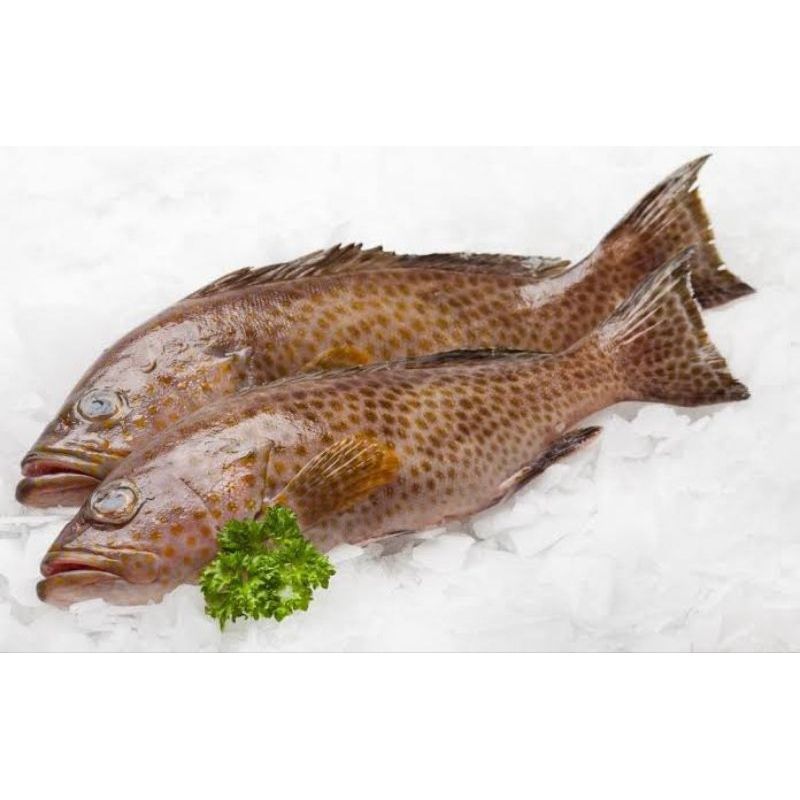
Unlike Golden Pomfret, Cantang Grouper can leverage Indonesia’s established position in international grouper trade. The country already maintains export networks across key Asian markets, particularly China and Hong Kong, where demand for live grouper remains strong.
However, these markets primarily favor premium species such as Sunu, Tiger, and Mosso Grouper, limiting Cantang Grouper’s direct competitiveness in the premium live-fish segment.
Instead, Cantang Grouper offers stronger opportunities in frozen and processed seafood markets, where buyers place greater emphasis on product specifications, consistent quality, competitive pricing, and reliable supply rather than species preference alone.
Consequently, the strategic priority shifts from building market recognition to strengthening supply-chain coordination and aligning production with established buyer requirements. This distinction creates a different pathway to export growth, centered on improving operational reliability and capturing demand through existing trade channels.
| Global Market Preferences and Their Relevance to Indonesian Cantang Grouper | |||||
| Area | Country | Market Preferences | Product Form | Key Product Attributes | Relevance to Cantang Grouper |
| North America | United States of America | Buyers prioritize texture, color, taste, food safety, and consistency of supply over specific types of grouper. | Frozen fillets, cuts, processed products | White flesh, mild flavor, firm texture, consistent quality, reliable frozen supply | High– Cantang grouper has the potential to be a raw material for cultivation for frozen fillets and processed products with a consistent supply. |
| Southeast Asia | Vietnam, Malaysia, Singapore | Species preferences are relatively flexible; Vietnam also has the potential to become a processing and redistribution hub. | Live fish, fresh whole, frozen whole, fillets | Competitive prices, supply availability, size uniformity | Medium–High– Potential entry if prices are competitive and supply is consistent, with demand dependent on buying channels and species preferences. |
| East Asia | China, Hong Kong | Strong preference for premium live grouper, especially Sunu and Tungsing, with trade concentrated in Hong Kong and China. | Whole live fish, whole fresh fish | Freshness, appearance, premium type, dense texture, perception of quality of caught fish | Low–Medium– Potential to enter the live/fresh fish segment at a more affordable price, but less relevant to premium buyers. |
| Middle East | Arab Saudi Arabia, UAE, Yemen, Oman, Qatar, Kuwait | Buyers tend to choose wild-caught Mosso Grouper over farmed Cantang Grouper. | Fresh/frozen whole fish, without head, without guts | Dense texture, large size, strong flavor, perceived quality of caught fish | Low–Medium– Potential is still limited because buyers prefer freshly caught Mosso Grouper. |
| Europe | European Union countries | The market prioritizes compliance with standards and product quality, with a trend towards demand for standardized fishery products. | Frozen fillets, cuts, processed products | Traceability, certification, food safety, hygienic handling, quality consistency | Low–Medium– Potential for processed products, but market access is hampered by strict requirements and limited buyer knowledge. |
The United States represents a priority market for Cantang Grouper, supported by established demand for frozen fillets and processed seafood products. Meanwhile, Vietnam and the Middle East offer opportunities for broader product formats, particularly frozen whole fish, although buyer preferences and price expectations vary across markets.
Italy presents an additional opportunity given its relatively attractive import price benchmarks, but market entry requires compliance with more stringent food safety and regulatory standards.
Against this backdrop, Cantang Grouper’s export strategy should prioritize aligning product specifications with buyer requirements and strengthening existing trade channels, rather than building demand from scratch. This approach would enable Indonesia to capitalize on established market opportunities while improving product competitiveness and supply reliability.
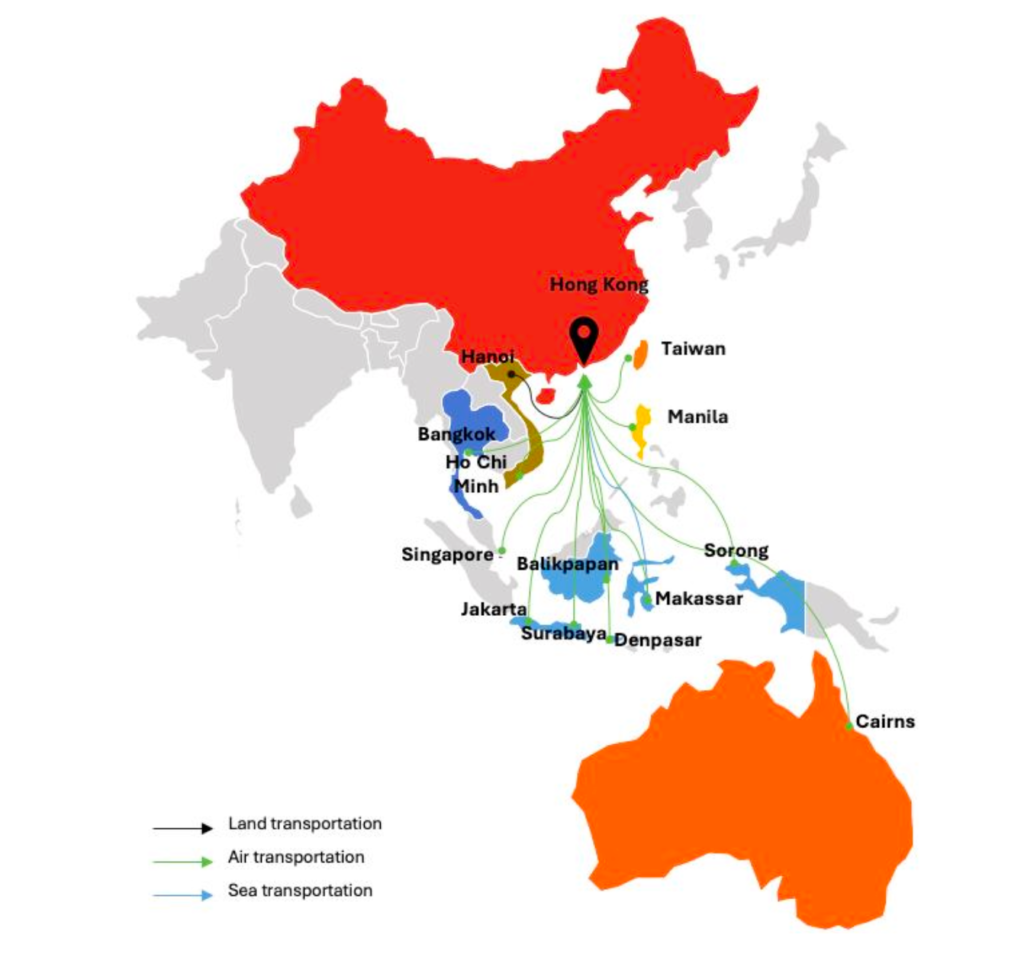
Competitive Pricing Needs to Be Supported by More Efficient Production
| Market Price Indications for Indonesian Grouper Export Routes | ||||
| Product Form | Main Market | Source of Raw Materials | Raw Material Price (Rp/kg) | Export Price Indication (Rp/kg) |
| Frozen fillets | US, Europe, Singapore | Other types of grouper – catches from various regions | 70.000 | 200.000 |
| Frozen fillets | US, Europe, Singapore | Cantang Grouper – Balinese cultivation | 100.000–150.000 | 300.000–400.000 |
| Frozen whole fish | Malaysia, Vietnam, Singapore, Middle East | Cantang Grouper – East Java cultivation | 90.000 | 130.000–160.000 |
| Frozen whole fish | Malaysia, Vietnam, Singapore, Middle East | Mosso Grouper – catch from Eastern Indonesia | 100.000–150.000 | 300.000–400.000 |
| Premium live fish | China, Hong Kong | Tungsing Grouper – a catch from Eastern Indonesia | 250.000 | 400.000 |
| Premium live fish | China, Hong Kong | Sunu Grouper – catch from Java and Natuna | 400.000 | 900.000 |
Note: Prices reflect indicative transactions across different trade channels rather than national averages. The gap between raw material and export prices does not represent profit margins, as it excludes processing yields, processing expenses, logistics, and other export-related costs.
To strengthen its export competitiveness, Cantang Grouper must improve production efficiency and reduce farm-gate prices from the current IDR 85,000–95,000/kg toward a target of IDR 70,000–75,000/kg. Achieving this target requires higher productivity, more efficient feed management, and reliable access to quality fingerlings.
One key challenge is the industry’s continued reliance on trash fish as feed, which can create inconsistencies in feed efficiency, harvest quality, and operational performance. To address this, farmers can gradually transition to commercial pellet feed to improve feeding practices and production consistency.
However, the economic benefits will depend on balancing feed costs against improvements in fish growth and productivity. In parallel, strengthening seed quality and farming practices will be essential to improve survival rates and maintain consistent harvest volumes.
Nevertheless, farm-level efficiency improvements alone will not ensure export competitiveness. Producers must also coordinate more closely with suppliers, traders, and buyers to translate production gains into reliable commercial supply.
Strengthening Market Access Through an Integrated Business Model
Beyond improving production efficiency, Cantang Grouper must strengthen coordination across its value chain to meet export market requirements consistently.
To address this need, the assessment proposes an integrated business model connecting hatcheries, nurseries, feed manufacturers, farmers, traders or cooperatives, and end buyers to align production with market demand.
Within this model, feed manufacturers support production planning and provide technical assistance to improve feed efficiency and farming productivity. Meanwhile, traders and cooperatives serve as key market connectors, aggregating harvest volumes, coordinating product quality and distribution, and facilitating offtake arrangements with buyers.
By clarifying responsibilities and strengthening coordination among stakeholders, the model enables more predictable production, consistent product quality, and reliable delivery, positioning Cantang Grouper to capture greater opportunities in established export markets.
Recommendation of Business Models for the Cantang Grouper Fish Industry
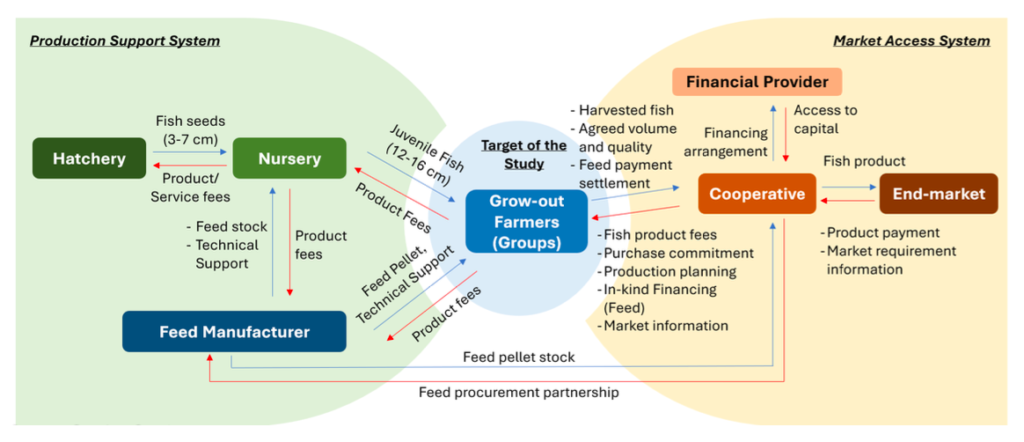
Within this model, traders and cooperatives play a central role in connecting production with market demand. They aggregate harvest volumes, coordinate quality standards, and manage distribution to ensure products meet buyer requirements.
This coordination is particularly important as export buyers require consistent volumes, standardized quality, and reliable delivery schedules. By aligning production planning with market demand, farmers can better anticipate harvest requirements, while traders and exporters can secure more predictable supply.
Ultimately, Cantang Grouper’s growth potential depends not only on increasing production, but also on building an integrated and reliable supply chain capable of consistently serving international markets.
Barramundi: Converting Market Opportunities into Reliable Export Supply
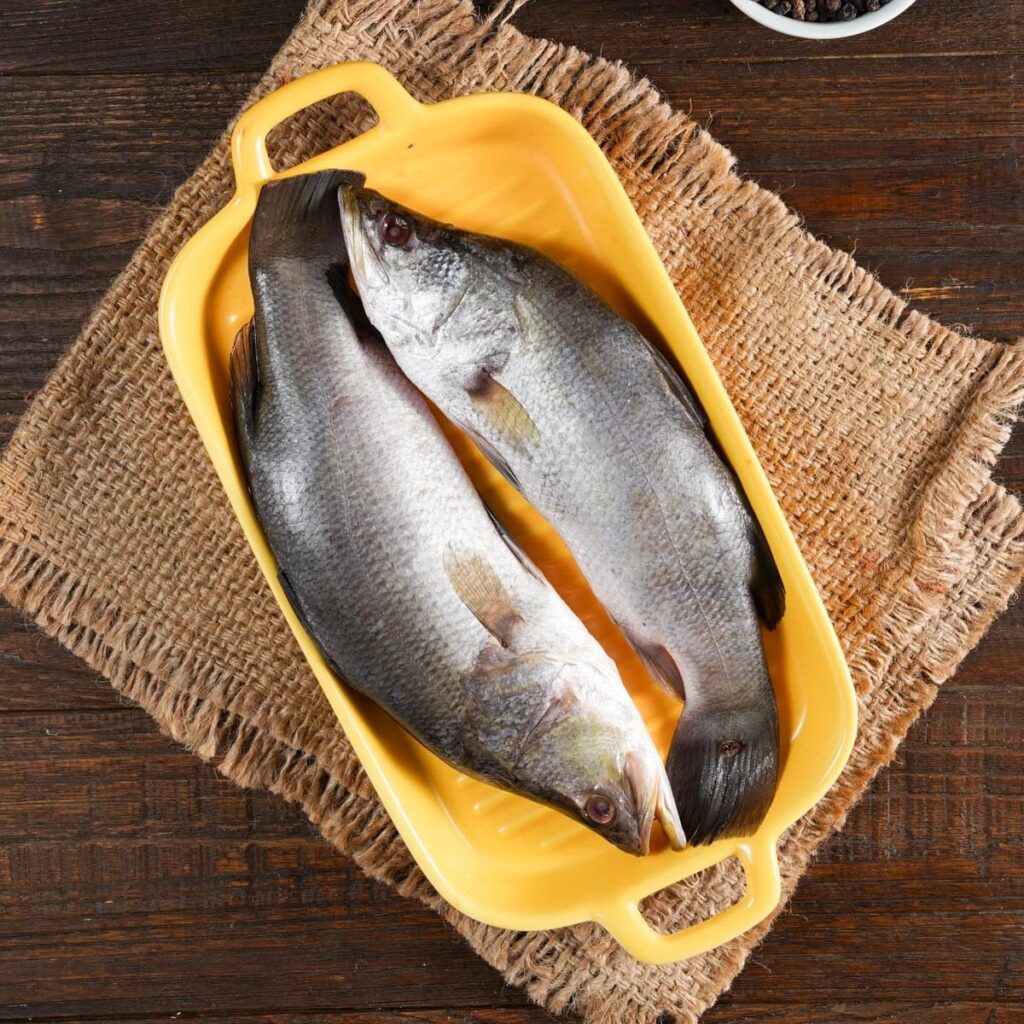
While Cantang Grouper must strengthen supply-chain integration to capture existing demand, Barramundi faces a different challenge: translating established market familiarity into competitive and reliable export supply.
Barramundi already benefits from strong product recognition in several international markets, particularly Australia, where consumers widely recognize it as a food fish. This familiarity provides Indonesia with an established foundation for expanding its export presence.
However, market opportunities vary by product form and buyer requirements. Australia and the United States offer opportunities for frozen fillets and portion cuts, while Southeast Asia and the Middle East are more oriented toward fresh and frozen whole fish. Meanwhile, Europe presents selective opportunities for processed products, subject to stringent quality and regulatory standards.
Given these established market opportunities, Barramundi’s strategic priority is not to build product awareness from scratch, but to strengthen production efficiency, processing readiness, and supply reliability. These capabilities will be critical to converting existing buyer interest into consistent export orders and sustainable commercial growth.
Discover More: The Future of ASEAN: Building Economic Resilience Through Regional Trade
| Global Market Preferences and Their Relevance to Indonesian White Snapper | |||||
| Area | Country | Market Preferences | Product Form | Key Product Attributes | Relevance to White Snapper |
| Oceania | Australia | White Snapper has become widely recognized as a local food fish, with demand from retailers, restaurants, and households. Imports have the potential to supplement domestic supply. | Fresh/chilled whole fish, frozen fillets, pieces, fillets with skin | Mild taste, firm white flesh, freshness, uniform size, hygienic handling, reliable supply | High– Market familiarity supports exports, but Indonesia needs to compete with domestic producers and meet stringent quality, traceability, and food safety standards. |
| North America | United States of America | There is increasing interest in White Snapper as a white-fleshed fish that is easy to process, especially for the retail and restaurant segments. | Frozen fillets, cuts, fillets with skin, value-added products | Mild taste, consistent quality, ease of processing, sustainability, reliable supply | High– Relevant for frozen and processed products, with the need to strengthen food safety, product positioning, and supply consistency. |
| Southeast Asia | Singapore, Malaysia | There is high familiarity with Asian Seabass, with demand supported by seafood consumption and the restaurant sector. | Fresh whole fish, live/chilled fish, frozen whole fish | Freshness, regular supply, consumption size, balance of price and quality | Currently– Supported by geographical proximity, regional market familiarity, and the existence of Indonesian White Snapper supply lines. |
| East Asia | China, Hong Kong, Japan | There is demand for premium fishery products, but White Snapper is not yet as popular as other types of white-fleshed fish or live seafood. | Fresh/chilled whole fish, frozen whole fish, fillets | Freshness, clean taste, consistent quality, food safety | Low– Market opportunities exist, but require product introduction and strengthening of positioning to buyers. |
| Southeast Asia | Vietnam | White Snapper is positioned as a premium white-fleshed fish fillet and is used in export-oriented fishery products. | Whole fish, frozen fillets, fillets with/without skin | Dense texture, mild flavor, processing flexibility, premium fillet quality | Low– Potentially competitive if the price and product form are appropriate, but Vietnam is also a strong competing supplier. |
| Europe | European Union countries, UK | The market prioritizes quality and adherence to standards. White Snapper has the potential to be positioned as a white-fleshed farmed fish, requiring clear labeling. | Frozen fillets, pieces, frozen whole fish | Traceability, certification, sustainability, labeling accuracy, consistent quality | Low– Potential for certified and traceable farmed products, but market access is more difficult due to the stringent standards and sensitivity of seabass species labeling. |
Export Opportunities Exist, but Farmed Supply Remains Concentrated in Live-Fish Trade
Export demand is established, but Indonesia’s farmed Barramundi supply has yet to align with processed-market requirements.Meranti’s farmed Barramundi reaches Malaysia and Singapore live through Batam traders, while frozen exports still rely on wild-caught fish.
This distinction highlights a critical development priority: strengthening the integration of farmed Barramundi into export-oriented processing and distribution channels. Doing so will require more consistent production volumes, competitive costs, and reliable product quality to meet international buyer requirements.
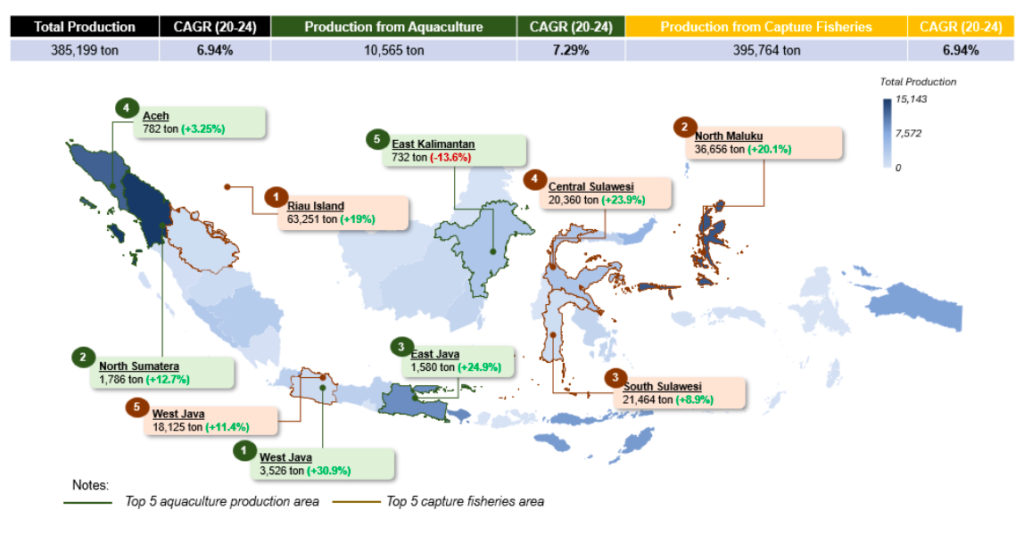
Distribution of Snapper Production in Indonesia Based on Type of Fishery Production (KKP data portal, 2024)
Therefore, established export demand for Barramundi does not necessarily translate into export readiness for farmed production. To bridge this gap, Indonesia must strengthen production consistency and expand processing capabilities to ensure farmed Barramundi can meet international buyer requirements for volume, quality, and product specifications.
Improving Production Efficiency to Capture Export Market Opportunities
| Market Price Indications for White Snapper (Barramundi) Exports in Indonesia | ||||
| Product Form | Main Market | Source of Raw Materials | Raw Material Prices | Export Price Indication |
| Frozen whole fish | Australia, Middle East | Catches from Sumatra, East Java, Bali, and Eastern Indonesia | Rp60.000–70.000/kg | Rp100.000/kg |
| Frozen fillets and pieces | Australia, United States, Europe | Catches from Sumatra, East Java, Bali, and Eastern Indonesia | Rp60.000–70.000/kg | Rp200.000/kg |
Arghajata’s Research and Analysis
The assessment highlights a key challenge to Barramundi’s export competitiveness: current farm-gate prices leave limited room to capture value from international markets. Farmed Barramundi typically sells for IDR 80,000–90,000/kg, reaching approximately IDR 100,000/kg through certain trading channels in Batam. Meanwhile, indicative export prices stand at IDR 100,000/kg for whole fish and IDR 200,000/kg for fillets and portion cuts.
However, these export benchmarks largely reflect products sourced from wild-caught fisheries and are not directly comparable with farm-gate prices. Processing yields, facility costs, logistics, and export compliance requirements all influence the commercial viability of processed exports.
To close this competitiveness gap, the assessment identifies a target farm-gate price of IDR 65,000–70,000/kg, supported by improvements in production efficiency and productivity. Key priorities include strengthening fingerling quality, increasing survival rates, optimizing feed efficiency, and improving farming practices to deliver more consistent and cost-competitive production.
Nevertheless, increasing production volumes alone will not secure export growth. Indonesia must also strengthen quality consistency, processing readiness, and cold-chain capabilities to convert favorable market signals into reliable supply and repeat export orders.
Aligning Production, Processing, and Export Markets
Building on these improvements, Barramundi’s export growth requires closer coordination between farmers, processors, and exporters to align production with international buyer requirements.
Farmers must plan production around buyer specifications for fish size, quality, and volume, while processors and exporters need predictable harvest schedules and consistent supply to fulfill delivery commitments.
By connecting production planning with processing capacity and market demand, an integrated business model can strengthen supply reliability, improve operational efficiency, and enable farmed Barramundi to capture a greater share of export opportunities.
Recommendation of Business Models for the White Snapper Industry
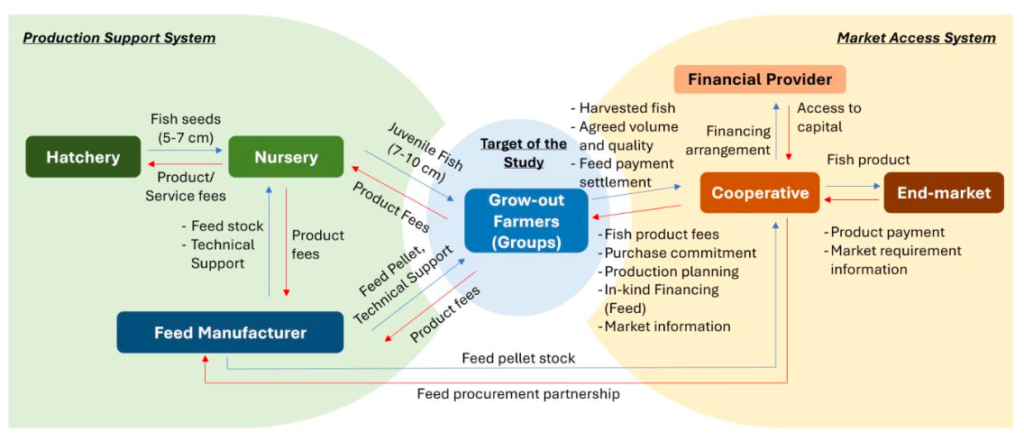
Effective execution requires coordination across the entire value chain, from fingerling availability, feed supply, and harvest planning to quality control, processing, cold storage, and export logistics. In this context, long-term commercial partnerships are essential to move beyond transactional sales and establish more predictable supply arrangements and repeat orders.
By aligning production and processing with buyer requirements, an integrated supply model can strengthen farmed Barramundi’s participation in export markets that currently rely heavily on wild-caught supply.
Conclusion
The assessment of Golden Pomfret, Cantang Grouper, and Barramundi reveals a broader insight, export potential exists across all three commodities, but differences in market readiness and production capabilities require distinct development strategies.
For Golden Pomfret, the immediate priority is to build buyer acceptance and improve price competitiveness before scaling production. In contrast, Cantang Grouper can leverage established trade channels by strengthening supply-chain coordination and aligning product specifications with buyer requirements.
Meanwhile, Barramundi must improve farmed supply competitiveness, processing capabilities, and delivery reliability to capture opportunities in established export markets. These differences highlight why production expansion alone cannot drive sustainable export growth. Instead, each commodity requires a phased development approach that reflects its market maturity, production readiness, and commercial requirements.
Nevertheless, a common priority emerges across all three commodities: aligning market demand with competitive production and reliable distribution. Without validated demand, expanding production risks creating excess supply. Conversely, without efficient production and consistent delivery, established market opportunities may not translate into sustained export growth.
Ultimately, the path to export competitiveness lies in addressing each commodity’s specific constraints while strengthening coordination across the broader aquaculture value chain.
Turning Export Opportunities into Coastal Economic Growth
Expanding aquaculture exports offers Indonesia an opportunity to generate economic value beyond fish production. Unlocking export potential for these three species requires aligning market demand, production capabilities, and supporting infrastructure.
A connected aquaculture value chain could boost farmer incomes, create jobs, and attract investment in export-ready processing and cold storage. However, export growth does not automatically translate into sustainable community benefits.
Long-term impact depends on competitive production, inclusive business partnerships, environmental safeguards, and consistent market demand. Government support in market development, infrastructure, financing, and technical assistance can help address these challenges.
Beyond exports, the real opportunity is building a competitive, sustainable aquaculture ecosystem that creates lasting value for coastal communities.
Source and Methodology: This article draws on the Feasibility and Market Assessment of Golden Pomfret, Cantang Grouper, and Barramundi, incorporating industry consultations, field observations, and national and international secondary data.
Where species-specific trade data is unavailable, broader fisheries categories provide indicative market benchmarks rather than precise species-level demand estimates. Price figures reflect market observations and indicative benchmarks, while production efficiency targets represent simulated scenarios rather than realized outcomes.