

In almost every corporate boardroom, one paradox consistently emerges in discussions about business transformation: the larger the budget, the higher the risk of failure. This is not merely speculation.
Research conducted by McKinsey, surveying 1,793 executives across industries, found that only 16% of digital transformations truly succeeded, both in improving performance and sustaining those improvements over the long term. In traditional industries such as oil and gas, automotive, and pharmaceuticals, the figures are even more alarming, with success rates ranging from only 4–11%.
What is even more surprising is not the number itself, but the fact that it has barely changed over the past two decades. In 2020, BCG confirmed a similar failure rate: 70% of the more than 850 companies it analyzed failed to achieve their intended transformation value.
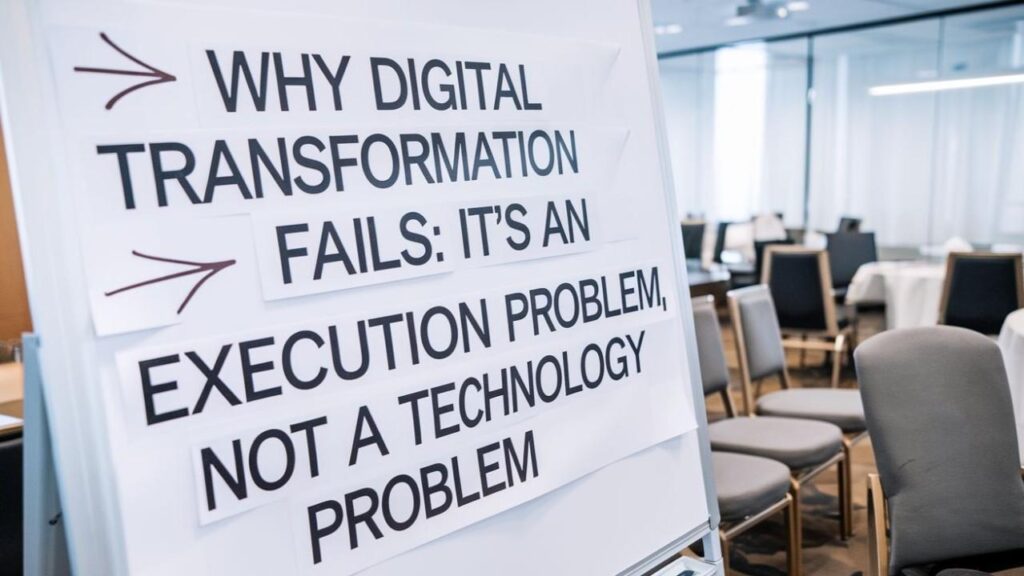
These failures are not primarily caused by a lack of technology or funding. They occur because organizations continue to start with the wrong question: “What should we implement?” rather than “What do we actually need to change?”
Transformation Is Not Merely a Project. It Is an Intervention into Organizational Identity.
Most business transformation programs are still treated like construction projects. They have budgets, timelines, milestones, and are considered complete once all deliverables have been implemented. While this approach is effective for managing technical implementation, it often fails to recognize a fundamental reality: organizations are not static machines whose components can be replaced one by one without altering their underlying character.
At their core, organizations are living socio-technical systems. Within them exist complex behavioral patterns, informal power structures, collective habits, hidden incentives, and shared narratives about “how to survive” that have developed over many years. These layers often determine how a company truly operates, far more than the formal structures displayed on presentation slides.
As a result, when companies adopt a new ERP system, AI-based solutions, or the latest digital platforms without changing the underlying logic of how work is performed, the transformation often becomes cosmetic. The organization may appear more modern, but in reality it has merely digitized old dysfunctions.
This is precisely the issue explored by Harvard Business Review through the work of Thomas H. Davenport and George Westerman. Many companies fail not because they lack technology, but because they are unwilling to change how the organization actually works. The problem is not the tools being used. The problem lies in operational assumptions that are never questioned.
At this point, transformation can no longer be understood as an implementation project. It more closely resembles an intervention into organizational identity, forcing a company to redefine how decisions are made, how value is created, how risk is understood, and how people collaborate within the organization.
Discover More: 3 Common Misconceptions About Sustainability Mindset Every Company Must Understand
Three Myths That Destroy Transformation Programs
Over the past decade, business transformation has become a strategic priority across nearly every industry. Companies have rushed to adopt ERP systems, automation, data analytics, and AI in an effort to improve efficiency and maintain competitiveness.
Yet despite these significant investments, many organizations find themselves trapped in transformations that are only partially successful. New systems are implemented, but old ways of working remain intact. The issue often lies not in the technology itself, but in how organizations understand transformation. This is where many transformation programs begin to lose direction, built upon assumptions that sound logical but ultimately become sources of failure in practice.
At least three major myths continue to undermine modern transformation efforts.
Myth One: Technology Leads Change
This may be one of the most expensive and persistent misconceptions in modern management history. Investments in AI, cloud computing, and automation continue to increase, yet research consistently shows that the greatest barrier to digital transformation is not technology, but organizational culture.
Analysis from McKinsey & Company has found that organizations that invest seriously in cultural change achieve transformation success rates several times higher than companies that focus exclusively on technology implementation.
The reason is straightforward. Technology is merely an enabler. It creates new possibilities, accelerates processes, and expands organizational capacity. However, the decision to adopt it, how it is used, the extent to which work behaviors change, and whether people within the organization trust the transformation remain fundamentally human issues rather than technical ones.
Myth Two: Transformation Is an Executive Matter
A common pattern emerges in large transformation programs. Alignment appears strong at the executive level but begins to fragment when translated into operational reality.
Senior leaders may agree on the direction of change, yet among middle managers, the group that actually executes transformation on a daily basis, priorities, interpretations, and implementation approaches often evolve differently without sufficient coordination. As a result, transformation appears cohesive on presentation slides but fragmented in practice.
This phenomenon highlights an important reality: transformation success is determined not only by the quality of strategy but also by an organization’s ability to maintain alignment across every layer. Research from McKinsey & Company indicates that involving a chief digital officer can improve the likelihood of transformation success. In practice, however, the individuals who often have the greatest impact are middle managers.
They serve as the bridge between strategic vision and operational reality. More importantly, they determine whether change is genuinely translated into everyday work behaviors.
For this reason, ignoring them, or treating them merely as administrative executors, often becomes one of the most damaging mistakes in any transformation program.
Myth Three: Speed Always Means Progress
In many transformation programs, the greatest pressure does not come from the complexity of change itself, but from the demand to show results as quickly as possible. Organizations rush to produce quick wins so that transformation appears to be moving forward: new dashboards are presented, internal applications are launched, processes are redesigned, and various initiatives are labeled as proof of “change momentum.” Visually, the organization looks fast-moving. But movement is not the same as progress.
The problem is that many transformations only touch the surface layer of the organization without changing the core logic of how work is actually done. Core workflows remain unchanged. Decision-making is still dominated by intuition and hierarchy rather than data. Silos between departments remain stronger than cross-functional collaboration. In some cases, new technology even adds complexity because it is layered on top of outdated processes that should have been redesigned first.
Boston Consulting Group described this phenomenon as “motion without progress” — a condition in which organizations appear highly active in transformation efforts but fail to build meaningful new capabilities. Activity increases, yet decision quality does not improve. Initiatives multiply, but coordination remains weak. The organization becomes busy sustaining the appearance of transformation without truly transforming.
At a certain point, this pattern becomes dangerous. It does not only waste budgets and organizational energy; it also gradually erodes internal trust in change itself.
Discover More: How SME Management Consulting Helps MSMEs Transition to the Corporate Level
Where Should Transformation Actually Begin?

Across many transformation efforts in different industries, one pattern repeatedly separates successful programs from failed ones. The difference is rarely the framework being used, whether Agile, Lean, OKRs, or another management approach.
What matters far more is the sequence of intervention: what is changed first, which areas are addressed early, and whether the organization builds a foundation for change before accelerating execution.
1. Diagnose Before Prescribing
Many transformation programs fail because organizations move too quickly toward solutions before fully understanding the problem. Technology is selected, roadmaps are drafted, and implementation begins without a deep understanding of how the organization actually works.
Transformation should therefore begin with something like an organizational X-ray: mapping how decisions are truly made, where information gets stuck, and which informal dynamics shape day-to-day behavior. The analysis must go beyond formal structures and examine the operational realities that rarely appear on org charts.
Without this level of diagnosis, transformation almost always becomes reactive. Resistance emerges in unexpected areas, while the organization spends its energy treating symptoms rather than addressing root causes.
2. Build a Credible “Why”
Sustainable transformation is rarely driven solely by competitive pressure or industry trends. People do not fundamentally change simply because leadership says the market is changing. They change when they understand why the change is necessary and how it will affect their daily work.
Every transformation therefore requires an internal narrative that is credible, relevant, and honest enough to explain the real situation. Not a slogan about innovation or future readiness, but a clear answer to the employee’s most practical question: “What does this change mean for my work tomorrow?”
When organizations fail to answer that question clearly, the vacuum is usually filled by speculation, anxiety, and passive resistance. Transformation is then perceived as management’s agenda rather than a shared organizational necessity.
3. Strengthen the Middle Layer of the Organization
In many transformations, middle managers are treated merely as execution arms. In reality, they are often the most important actors in translating change into daily behavior. Empowering them requires more than communication sessions or formal training. They need the authority to make decisions, experiment, and adapt implementation to operational realities on the ground.
Transformation slows dramatically when every initiative is controlled centrally from the top. Organizations that succeed usually build change capacity from the middle of the organization outward.
4. Scale What Actually Changes Behavior
Many organizations rush into large-scale rollouts because they want to demonstrate rapid progress. But scale is not proof of success. A small pilot that genuinely changes how a team works is often far more valuable than a massive implementation that creates new procedures without changing real behavior.
Sustainable transformation typically grows from practices that prove effective at the operational level and then spread organically because people experience their value firsthand. That momentum tends to last much longer than change imposed merely to satisfy management targets or implementation deadlines.
5. Measure Behavioral Change, Not Just System Activity
Organizations often declare transformation successful when a new dashboard is active, systems are integrated, or digital features are launched. Those indicators only show that technology has been implemented, not that the organization has changed.
The more important questions are these: Are decisions now being made differently? Has cross-functional collaboration improved? Have everyday work behaviors changed in a meaningful way?
Ultimately, real transformation is measured not by the number of tools deployed, but by changes in mindset, interaction patterns, and decision-making across the organization.
Size Is Not the Obstacle. Inertia Is.

One of the most frequently misunderstood findings from McKinsey’s research is that companies with fewer than 100 employees are 2.7 times more likely to succeed in digital transformation than organizations with more than 50,000 employees. This finding is often interpreted as proof that large companies struggle to transform.
That interpretation is not entirely accurate.
Smaller organizations tend to succeed not because of their size, but because they operate with lower levels of inertia. They typically have fewer legacy systems, shorter decision-making cycles, and greater ease in building trust across functions. In other words, the real challenge for large organizations is not to imitate the agility of smaller companies. The challenge is to deliberately and systematically reduce their own internal inertia.
This is fundamentally a structural and cultural challenge rather than a technological one.
Discover More : M&A (Merger & Acquisition): Growth Strategy or Shortcut?
Three Questions for Leaders

Before transformation budgets are approved and roadmaps begin to move forward, there are three questions that leadership teams should answer honestly.
The first question is whether the leadership team truly agrees on what success looks like. Not in the language of KPIs or strategy presentations, but in terms of observable behaviors they expect to see throughout the organization. Many transformations fail not because the strategy is weak, but because leaders quietly operate with different definitions of success.
The second question is whether leaders themselves are prepared to change the way they work.
Transformations built on the assumption that “other people need to change” almost always lose credibility. Organizations tend to follow the behavior of their leaders far more closely than they follow presentations or internal communications. For that reason, change that is not modeled from the top usually remains nothing more than an internal slogan.
The third question is whether the organization has a safe environment in which small-scale failures can occur.
Transformation inevitably involves experimentation, uncertainty, and repeated adjustments. Organizations that successfully adapt are not organizations that avoid mistakes altogether. They are organizations that learn quickly before small failures evolve into larger crises. Unfortunately, this type of psychological capacity is rarely developed intentionally as part of a transformation roadmap.
Conclusion
Business transformation is ultimately not about installing new technology or accelerating existing processes. It is a process of redesigning how an organization thinks, makes decisions, and creates value in an increasingly complex business environment. As a result, successful transformation almost always begins with the willingness to confront internal realities honestly before deciding what needs to change.
Many companies already know which areas are constraining their growth: overly bureaucratic structures, slow decision-making, fragmented collaboration, or workplace cultures that are no longer aligned with current business demands. The challenge is rarely a lack of technology or management frameworks. The real challenge lies in the organization’s ability to translate that awareness into consistent and sustainable change.
At this point, transformation is no longer merely a strategic initiative. It becomes a decision about what kind of organization the company intends to be in order to survive and grow in the future.
If your organization is currently facing transformation challenges, Arghajata Consulting helps companies build transformation programs that go beyond system implementation and create meaningful changes in how organizations work, collaborate, and make decisions.