
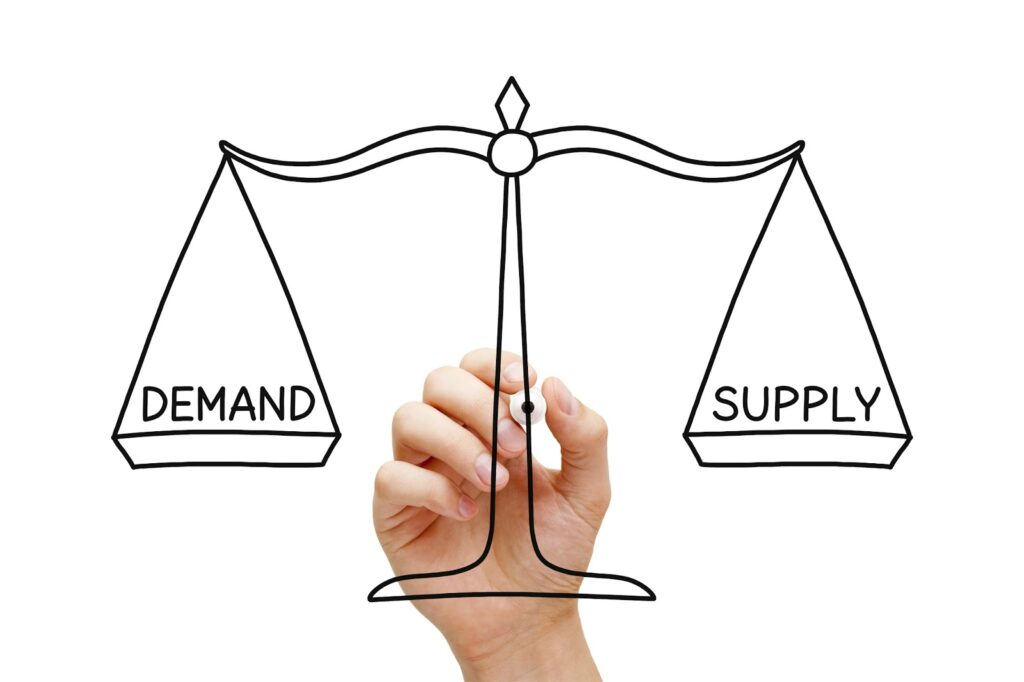
As is widely known, supply and demand are almost never perfectly synchronized; the two often do not meet at the same point. This happens because companies build production capacity based on what happened in the past.
Meanwhile, consumer demand changes much faster due to trends, economic conditions, and other external factors. Therefore, an imbalance between the two is actually normal, not an anomaly.
The problem is that many companies misread this situation. They often immediately conclude that rising prices mean demand is strong, or that declining sales volume means the market is weakening.
In reality, this way of thinking oversimplifies the issue. Prices, sales volume, and inventory buildup in warehouses are only surface-level symptoms, not a complete picture of the dynamics happening behind the scenes.
Therefore, understanding supply and demand cannot rely solely on numbers and reports. It requires the ability to see the context behind the imbalance. Companies must be able to distinguish between changes that are temporary and those that represent permanent shifts.
The objective is clear: supply and demand should no longer be treated merely as numbers in market reports, but as sharp strategic tools for determining pricing, capacity, and investment decisions. So, how can companies recognize signals of supply–demand imbalance? The following is a comprehensive explanation.
Recognizing Indicators of Market Imbalance
In practice, market indicators only become meaningful when read relationally, where one indicator confirms or contradicts another. Therefore, the biggest mistake companies make is not a lack of data, but a failure to interpret the combination of the following signals.
Backlog and Price
An increasing backlog is often interpreted as evidence of strong demand. Logically, this assumption makes sense: when incoming orders grow faster than production capacity, backlog accumulates and price pressure increases. However, this interpretation is only valid if the market is still able to absorb price adjustments.
In some cases, a high backlog without a corresponding price increase often indicates contract rigidity, an inability to raise prices, or even operational inefficiency.
Conversely, rising prices without backlog growth can be an early signal that the market is beginning to resist those new prices.
Therefore, backlog and price should not simply be read as market indicators, but as a diagnosis of strategic positioning. The question is not whether backlog is rising, but whether that backlog reflects bargaining power or merely fragile accumulation.
Volume and Pricing
Volume is often considered the most objective indicator, yet it can be the most misleading when separated from price context. Increasing volume without improvements in pricing usually indicates a loose market, where excess capacity pushes competitors to compete through quantity rather than value. In this situation, volume growth is often achieved at the expense of margin erosion.
Conversely, rising prices without volume growth do not always reflect a weakening market. In many industries, this actually indicates supply limitations that allow players with strong positions to extract margins.
Problems begin to appear when price increases are followed by consistent volume declines. This signals that the tolerance limit of demand has been exceeded and the market has started adjusting.
What matters most is reading the direction of change rather than the absolute level. Weakening volume while prices remain stable often indicates the early stages of a cycle shift, long before pressure appears in financial reports.
If companies fail to read the interaction between volume and pricing simultaneously, they risk reacting too late because they are lulled by margins while the market has actually already begun changing direction.
Upstream and Downstream Inventory Patterns
Inventory is the indicator most often misinterpreted because it is inherently delayed. Inventory buildup is often immediately interpreted as weakening demand, whereas what truly matters is where in the supply chain that inventory accumulates.
When inventory increases upstream but decreases downstream, the market is usually experiencing temporary destocking. In this case, end consumption has not necessarily weakened; what has changed is the distribution behavior.
Conversely, inventory rising simultaneously across the entire supply chain almost always signals more structural demand pressure, because products stop moving even at points closest to consumers.
A common mistake occurs when companies only look at internal inventory without understanding the position of distribution partners and customers. Without supply chain context, inventory shifts from being an indicator to becoming an illusion.
Backlog, price, volume, and inventory never stand alone. Each of these elements is part of the same system and only becomes meaningful when interpreted together. Backlog without pricing power, volume without margin, or inventory without supply chain context will only produce short-term reactions.
Discover More : 6 Ways to Choose the Right Management Consulting Firm
Understanding Market Tightness

Market tightness is not determined by a single indicator, especially not by price alone. A market may appear “tight” because prices rise, even though the underlying foundation has already begun weakening. What truly determines tightness is whether operational indicators still support each other.
A market can be considered genuinely tight when price increases or stability are still supported by backlog that does not shrink, relatively stable volume, and inventory that does not accumulate upstream. In such conditions, producers tend to have bargaining power because demand is still able to absorb supply constraints.
Problems arise when this synchronization begins to break. Prices may remain high, but backlog shrinks. Volume weakens while inventory begins shifting upstream. This is not an anomaly, but an early signal that market tightness is fading, even if financial reports have not yet reflected it.
Reading market tightness means answering one core question: are current prices still supported by operational conditions, or are they standing alone without support? The answer to this question should guide pricing, capacity, and investment decisions.
Implications for Pricing
In a genuinely tight market, pricing functions as more than just a cost adjustment mechanism. It also becomes a tool for managing demand and filtering customer quality. Price increases implemented while backlog remains stable and volume remains intact usually do not damage market structure; instead, they strengthen producers’ negotiation positions.
However, when operational indicators begin losing support—for example when backlog shrinks or volume weakens—pricing must be reassessed. Prices that remain high often create the illusion of market strength, even though room for maneuver has already narrowed.
At this stage, a more effective strategy is not necessarily to push prices further, but to manage price structure through product differentiation, contract-based adjustments, or revising sales terms in order to maintain margins without sacrificing demand.
Implications for Capacity
Market tightness almost always encourages companies to expand capacity. When orders are full, backlog accumulates, and prices rise, this decision seems logical. However, such tight conditions are often temporary illusions, not because the market truly lacks long-term supply, but because capacity has not yet adjusted.
Problems arise when major investments are made based on this condition. Additional capacity requires time to materialize, and by the time it enters the market, conditions often have already changed. Demand slows, backlog shrinks, and the previously tight market begins loosening.
In such situations, new capacity no longer becomes an advantage but instead becomes a burden.
Implications for Investment and M&A
Changes in market tightness also influence the quality of investment opportunities. When the market is at the peak of tightness, valuations usually reflect excessive optimism and leave little margin of safety. Paradoxically, when tightness begins weakening, more rational opportunities often emerge even before pressure fully appears in financial performance.
However, this phase requires analytical caution. Cyclical weakening may open opportunities for strategic acquisitions, while structural weakening may signal that restraint is necessary.
Without sharp and selective supply–demand analysis, the difference between the two can easily be confused, turning investment decisions into disguised speculation.
Ultimately, changes in market tightness determine how much room companies have to manage pricing, adjust capacity, and make investment decisions. Misreading the direction of market tightness often does not only damage short-term performance but can lock companies into strategic decisions that are difficult to reverse.
Discover More : M&A (Merger & Acquisition): Growth Strategy or Shortcut?
Common Mistakes in Reading Supply and Demand

Errors in reading supply and demand rarely arise from a lack of data. On the contrary, they often result from excessive confidence in data interpreted separately and without time context. The following patterns of mistakes most frequently drive incorrect strategic decisions.
Overreliance on Forecasts
Forecasts are often used as maps of the future, whereas they are more accurately described as projections of the past. Forecasting models tend to assume trend continuity, while supply and demand move cyclically and are heavily influenced by decision time lags.
When forecasts become the primary basis for expansion or contraction, companies risk responding to conditions that have already passed rather than those currently forming.
The problem is not the forecast itself, but how it is used. Without being complemented by operational indicators, forecasts can create a false sense of security that delays corrective decisions until it is too late.
Misinterpreting Short-Term Signals
Short-term changes are often misinterpreted as fundamental shifts. For example, demand spikes caused by panic buying, destocking at the distributor level, or temporary supply disruptions are frequently interpreted as structural signals.
As a result, the decisions taken become too large for problems that are actually temporary.
This mistake usually occurs when companies fail to distinguish between noise and directional shifts. Without a time perspective, short-term signals appear more important than they actually are, leading to disproportionate strategic responses.
Reading Indicators in Isolation
Misreading indicators separately is not merely an issue of incomplete analysis; it reflects a misunderstanding of how market adjustments actually work. Each indicator moves at a different phase within the same cycle. However, when one indicator is treated as a single source of truth, companies unknowingly read the market out of sequence.
In such situations, strategic decisions are made based on lagging indicators rather than those leading the change.
The core problem lies not in the indicators themselves, but in the inability to arrange the sequence of signals. Without understanding which indicators lead and which follow, companies risk reacting too late when markets reverse, or too aggressively when pressure has already eased.
At this point, analytical errors turn into timing errors—and timing errors are almost always costly.
Conclusion
Supply and demand are often discussed as basic economic concepts, yet in real business practice they function as a complex signaling system that unfolds gradually and is full of interpretive traps.
The biggest mistake lies not in lacking data or indicators, but in failing to read the direction of imbalance, particularly when signals no longer move in alignment.
Backlog, price, volume, and inventory are not answers but clues. Their strategic value emerges when these indicators are arranged in the correct sequence and interpreted as a process rather than a snapshot.
This is precisely where many companies fail. Strategic decisions are often made based on lagging indicators, while early signals of change go unnoticed.
At Arghajata Consulting, we help companies read supply and demand dynamics not as market reports, but as the foundation for strategic decision-making—from pricing and capacity planning to long-term investment.